|
Cawdor Castle
The year 1066 - known as the date of the Norman Conquest - introduced feudal institutions into England. One of
these institutions was the castle and the feudal lord. In Scotland the introduction of feudalism and castles was not
until the 12th century. From his castle the lord administered his estates, the source of his position in society.
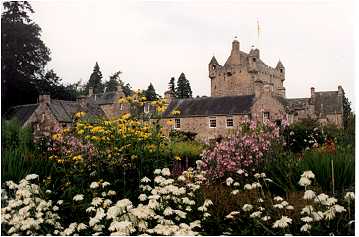
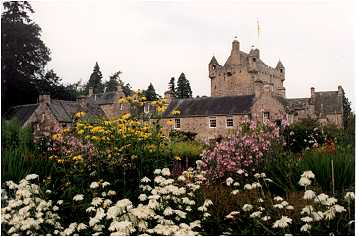
Cawdor Castle in the Highlands (5m SW of Nairn) is famous for its association with Shakespeare's drama Macbeth where it serves as the setting for the murder of Duncan, King of Scotland.
Duncan
This castle hath a pleasant seat; the air
Nimbly and sweetly recommends itself
Unto our gentle senses.
(William Shakespeare, Macbeth, Act I, Sc. VI)
 Over the centuries, the owners transformed the 14th-century
fortress into a hospitable residence. In 1454 King James II of Scotland permitted the Thane of Cawdor to fortify his castle on condition that it must always be ready for use by the king and his successors. Over the centuries, the owners transformed the 14th-century
fortress into a hospitable residence. In 1454 King James II of Scotland permitted the Thane of Cawdor to fortify his castle on condition that it must always be ready for use by the king and his successors.
The five-storey tower, built around 1380, is surrounded by 17th-century buildings which were enlarged afterwards. The Castle's gardens were first laid out in the 1720s. The estate's
flower and wild gardens are very pleasing to the eye.
TOP
|

